
If you’re looking for a reliable eggless vanilla cake that doesn’t taste vegan, look no further! I tested nine different recipes in one day in search of the best vegan vanilla cake that rivals the best conventional versions.
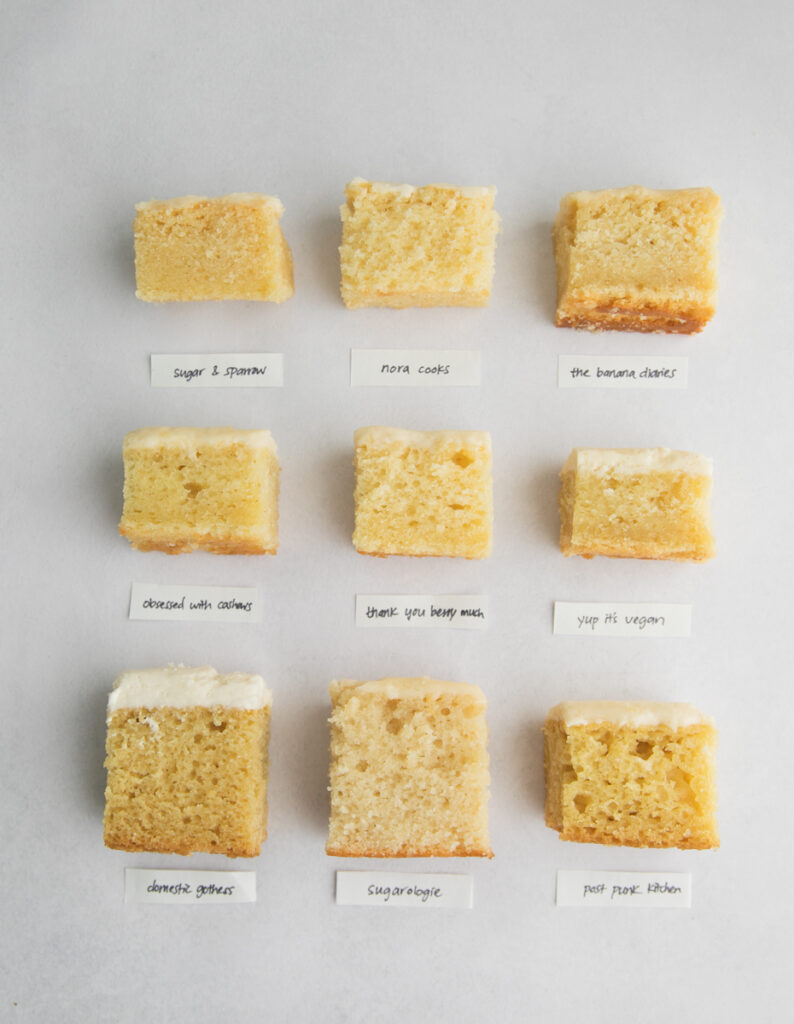
Even if you think you have no interest in vegan baking, I have several reasons why this bake off is relevant to anyone:
- You forgot to buy eggs at the store
- You’re baking a cake for someone who has an egg or dairy allergy
- You’re baking a cake for someone who is vegan
- You’re trying to bake a cake on a budget (many of these recipes use cheap pantry staples—think oil instead of butter, vinegar instead of eggs)
- You or friends for whom you’re baking are lactose-intolerant
The point is: there are many use cases for baking vegan besides being on a plant-based diet.
In my opinion, chocolate cakes tend to be easier to adapt to being vegan or eggless because the dominating cocoa flavor is very helpful to compensate for any missing ingredients. Vanilla cake, however, typically relies more heavily on eggs and dairy to carry flavor, and structure somehow feels more important–I’ve enjoyed many a dense and moist chocolate cake but never really enjoyed a dense vanilla cake??
I was so curious to see some of the most popular vegan vanilla cakes on the internet would perform, so let’s dive into this bake off! (If you’re happy to bake with eggs and dairy, I also have a conventional vanilla cake bake off! Not to mention a sprinkle cake bake off and a yellow cake bake off.)
Methodology
- I baked all nine cakes in one day (the same day as tasting for freshness)
- 41 total tasters rated samples of all nine cakes
- Each taster rated each cake on a scale from 0-10 for the cake and frosting (see Results section below for the overall ratings)
- Ingredients were measured by weight according to King Arthur (unless the recipe specified weights)
Ingredients
- Gold Medal bleached all-purpose flour
- Bob’s Red Mill unbleached cake flour
- Earth Balance buttery sticks
- Crisco shortening
- Wesson vegetable oil
- Silk soy milk
- Nielsen-Massey vanilla extract and paste
- McCormick butter extract
- Marukome organic reduced sodium white miso paste
- Aquafaba from Trader Joe’s chickpeas (note that aquafaba can vary greatly in texture from brand to brand! I find Trader Joe’s to be a bit inconsistent but it generally performs well for me.)
- Diamond Crystal kosher salt
Results
After asking 41 tasters to rate each of the nine vegan vanilla cake recipes, Nora Cooks came out as the number one pick. This was also my personal favorite cake!
There was a clear trend in these results with similar ingredient choices clustering together in the ranking. The top three cakes used both oil and vegan butter (as well as cake flour). The subsequent two recipes (Domestic Gothess and Sugar & Sparrow) used all vegan butter, and the last four recipes were mainly oil-based (Yup It’s Vegan also adds a bit of shortening).
In general, I found the cake textures of these to be pretty pleasing. When baking without eggs and dairy, it appears easy enough to get a satisfying texture similar to that of a conventional cake. The flavor is where I felt like most cake recipes struggled–while a couple had a nice prominent vanilla flavor, most carried the majority of the vanilla flavor in the frosting.
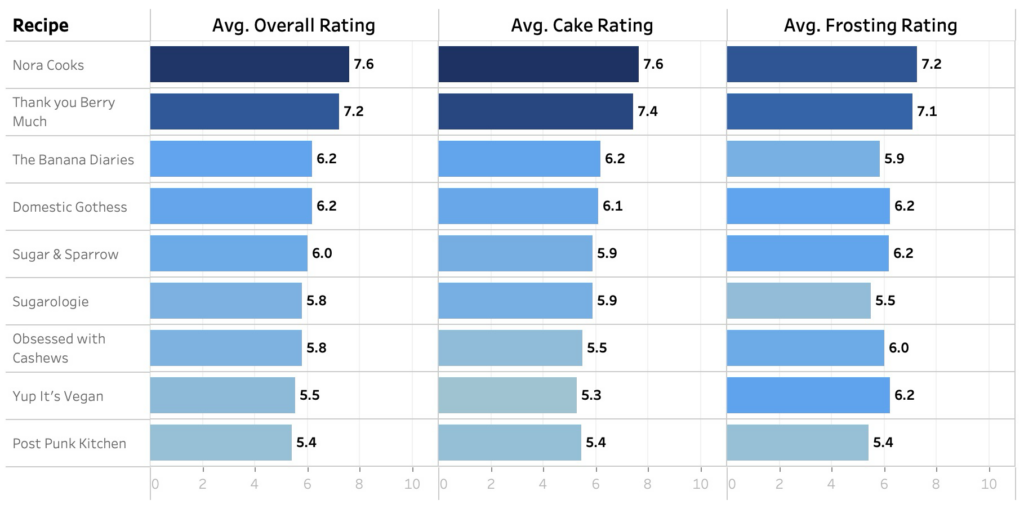
While the tasters did rate both the cake and frosting for each recipe, I focused mainly on the cake recipes in the analysis section. The cake recipes are rife with different baking factors while most of the frosting recipes were quite similar.
I made the same basic frosting for 6 of the recipes since they were so similar (Nora Cooks, Thank You Berry Much, Sugar & Sparrow, Obsessed with Cashews, Yup It’s Vegan and Post Punk Kitchen). It’s interesting to see how taster ratings varied wildly on the same frosting recipe–clearly, the cake rating had some influence on the frosting and vice versa.
As always, any baker error is my own (and I try to note it in the post). All of these recipes are strong in their own right and I recommend reading through the entire post to find a recipe that’s ideal for your personal preferences!
Factors
There were a few factors I considered when selecting the recipes to be tested, and they all focused on ingredient choices. Namely, would vegan butter vs. oil would reign supreme? Would tasters would prefer cakes made with aquafaba, plant-based milk or plant-based yogurt? What about imitation butter extract?
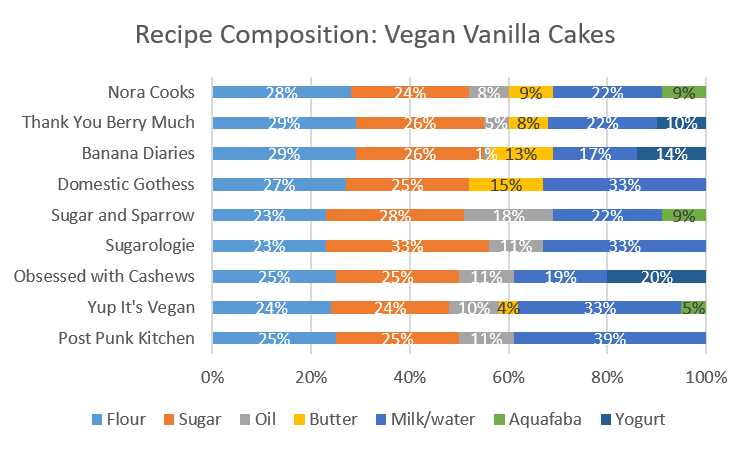
You can check out the general ingredient composition of each recipe and some of my conclusions below:
Vegan butter is best for texture and flavor
Because vegan butter is mainly composed of vegetable oils, I didn’t expect the fat source to vary that dramatically from cakes made with oil vs. butter. However, the only three cakes that used a combination of vegan butter and oil (Nora Cooks, The Banana Diaries, Thank You Berry Much) took the top 3 slots. This could be coincidence or due to other factors (the recipes are fairly similar), but it points pretty strongly to a taster preference for cakes made with oil and butter.
All three recipes also use either the creaming method (Nora Cooks, The Banana Diaries) or the reverse creaming method (Thank You Berry Much). The following two recipes which also use vegan butter (Sugar and Sparrow and Domestic Gothess) use the creaming method and melted butter, respectively.
I was curious to see what a combination of oil and shortening would do in Yup It’s Vegan, but there were so many other factors that it was hard to tell. I would think that shortening would perform similarly to vegan butter in a cake, just with less flavor.
My overall takeaway is that vegan butter is key to a desirable flavor in a plant-based cake–but combining it with oil likely leads to an even more desirable, moist crumb. And creaming the vegan butter is key for a fluffy crumb structure that will rival conventional cakes.
No need for egg substitutes, vinegar will usually do
In a conventional cake recipe, eggs provide protein, fat and emulsifiers to help build the crumb structure and bind the batter together. Of all nine recipes I tested, three recipes used aquafaba (otherwise known as chickpea brine) as the primary egg replacer. Another three recipes used plant-based yogurt, which adds moisture and binding power in place of the egg. Note that vegan yogurt adds no leavening qualities whatsoever whereas aquafaba, when whipped, can trap air into the batter similarly to egg whites.
The remaining three didn’t have an official egg replacer–they simply used a splash of vinegar. In conjunction with chemical leaveners (baking powder and soda), the acid in vinegar provides lift where eggs would normally capture air bubbles and set the airy crumb. In fact, seven out of the nine recipes used vinegar to help get extra lift.
Interestingly, virtually none of the 40 recipes in my initial collection round used egg substitutes like flax eggs, Just Egg or Bob’s Red Mill egg replacer.
There wasn’t really a clear pattern of which egg replacer was best between vegan yogurt, aquafaba or vinegar. The top three recipes used aquafaba, yogurt and yogurt respectively.
As a general rule when considering egg replacers in a cake, it would make sense to use aquafaba or vinegar when you want a really light crumb. Use vegan yogurt when you want extra moisture and a little more density!
Vegan cakes do tend to be more delicate, but all-purpose flour helps
Cake flour is a lower-protein flour often used in conventional vanilla cake recipes to get an ultra-fine and downy crumb. The same logic can clearly be applied to vegan cakes as the top three cakes all used cake flour and had a really nice delicate crumb structure (which can also be attributed to other factors but still!).
Out of all nine recipes I tested, the majority actually called for cake flour and only three recipes used all-purpose flour. All three had a strong rise and more structurally sound crumb (Domestic Gothess, Sugarologie, Post Punk Kitchen).
This could just be me, but I also think using cake flour might also help showcase vanilla flavor better than all-purpose flour. Stella Parks notes that bleached cake flour has an unusual starch content that makes it taste particularly sweet. Although I was using unbleached cake flour in this bake off, Nora Cooks had by far the best vanilla cake flavor to me and I wonder if it was due in part to her use of cake flour.
My takeaway: cake flour can provide a more delicate texture (and possibly a more vanilla-forward flavor) while recipes using all-purpose flour should be your pick if you want a sturdier (but still soft and tender) cake.
Butter extract isn’t necessary for great flavor
Could butter extract be the key to making plant-based cakes that taste like their butter-laden counterparts? According to the results of our two recipes made with butter extract (Yup It’s Vegan and Sugarologie), the answer is probably no.
Yup It’s Vegan uses a 1:1 ratio of vanilla to butter extract and I could barely detect any flavor in the cake itself. Meanwhile, Sugarologie uses 4 tsp of butter extract and only 3 tsp of vanilla extract along with 2 tsp of white miso paste for flavor. Personally, I found this flavor to lean a bit too umami (which could have been my brand of miso paste) and I’m not sure I got a clear buttery flavor either.
Overall, I feel like trying to chase the buttery flavor of a conventional cake in a vegan vanilla cake isn’t necessary. Most tasters were seeking a strong vanilla flavor and that comes from–surprise, surprise–vanilla extract!
A tip to improve your buttercreams
Since we’ll mostly focus on the cake recipes below, a quick note on frosting. All recipes in this bake off used a vegan vanilla buttercream–generally a mix of non-dairy butter, powdered sugar, vanilla, plant-based milk and salt. Sugarologie diverges slightly by adding sugar syrup (corn syrup in my case) to her frosting, which led to a softer texture that I didn’t prefer.
Only The Banana Diaries called for organic powdered sugar, which is a tip I learned from Buttermilk by Sam. Organic powdered sugar is typically made with tapioca starch, which literally melts on your tongue (vs. conventional powdered sugar is made with cornstarch, which only melts at high temperatures). If you want to take your buttercreams to the next level, try making it with organic powdered sugar!
Soy milk is the best replacement for cow’s milk
In researching this post, I found multiple articles citing soy milk as the best non-dairy milk for baking. This is mainly because soy milk contains the same amount of protein (8g protein per cup of milk) as cow’s milk, and protein can critically affect the structure of baked goods.
To that end, I used the same brand of soy milk (Silk) across all 9 recipes to give each recipe the best chance for success. Most recipes did call for soy milk, a few didn’t specify what kind of non-dairy milk–only Post Punk Kitchen specified almond milk. Although I typically try to follow the recipes exactly, my hunch was that using soy milk could only help the recipe’s performance slightly in this case.
If you can’t use soy milk or are curious about how other non-dairy milks perform, this King Arthur article is a great read!
Analysis of the best vegan vanilla cake recipes
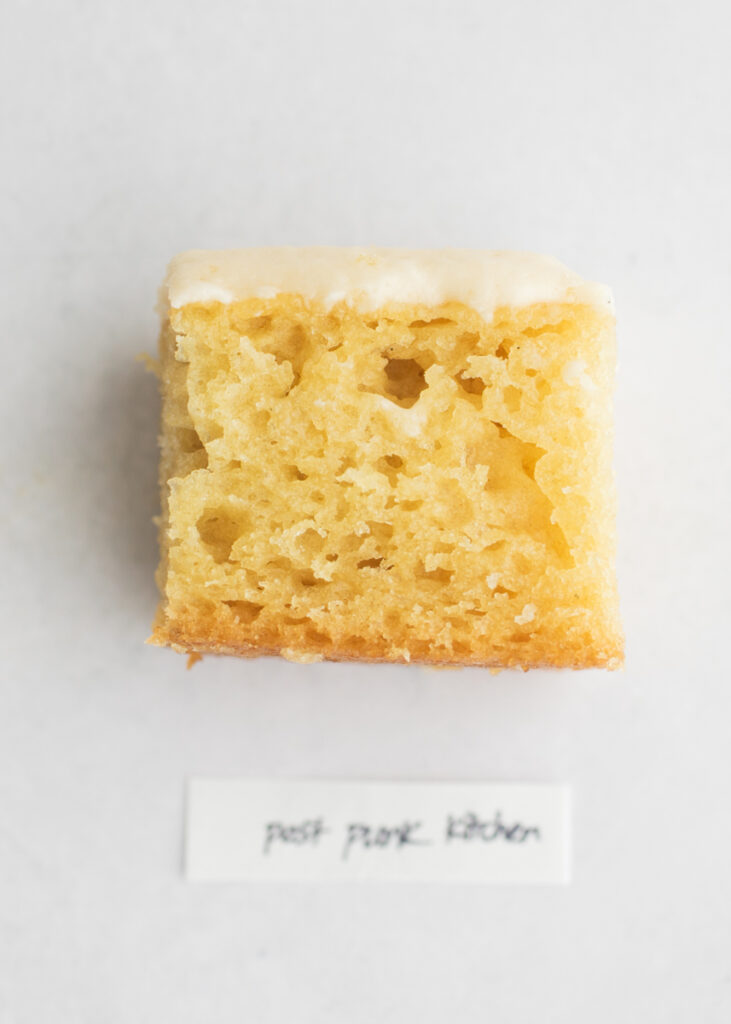
Post Punk Kitchen: a simple bouncy, coarse-crumbed cake with a straightforward flavor
“Wacky cake” (also known as depression cake or war cake) is a fairly common cake formula that’s typically accidentally vegan. It was developed around the time of the Great Depression, spurred by the scarcity of eggs, milk, sugar and/or butter. Water is often substituted for milk, oil for butter and baking powder and vinegar in place of eggs and the result is surprisingly delicious! Although there are a number of variations out there, I chose this recipe by Isa Chandra since I think of her as one of the pioneers of vegan baking. It’s an extremely simple oil based cake with all-purpose flour, a little cornstarch, vegan milk and vinegar.
Given how simple this cake is, it’s perhaps unsurprising that it had a fairly basic crumb. It’s the most open and coarse crumb of the bunch, though also surprisingly soft, moist and springy. I found the crumb a tiny bit oily and the flavor leans almost towards cornbread rather than vanilla. It’s an impressive cake for how simple it is, but it feels more like a pleasant snacking cake than a layer cake I’d make for a special occasion.
Taster comments:
- The cake was airy with a nice big crumb. The cake texture reminded us of nice fluffy bread. The frosting had a nice creamy texture and was not too sweet.
- It has a subtle almond flavor which I don’t mind but I think the consistency of the cake could be better. It’s not on the soft side. The frosting is also pretty sweet and tastes kind of tastes store bought.
- This cake is incredibly spongy, not in a soft, appealing way but in an unexpected, honeycomb way. The overly sweet icing has a sandy texture and a flavor of pure sugar.
- Cake feels more springy and glutinous-y and moist but also a little bready. Frosting felt a little oily.
- The cake texture reminded me of cornbread. Not really what I want my vanilla cake to do. Frosting good but not in my top 3, starting to approach the realm of sour.
- This tasted like a vegan cake, and not in a good way. It was definitely sweet, but the flavor incorporated too much imitation dairy.
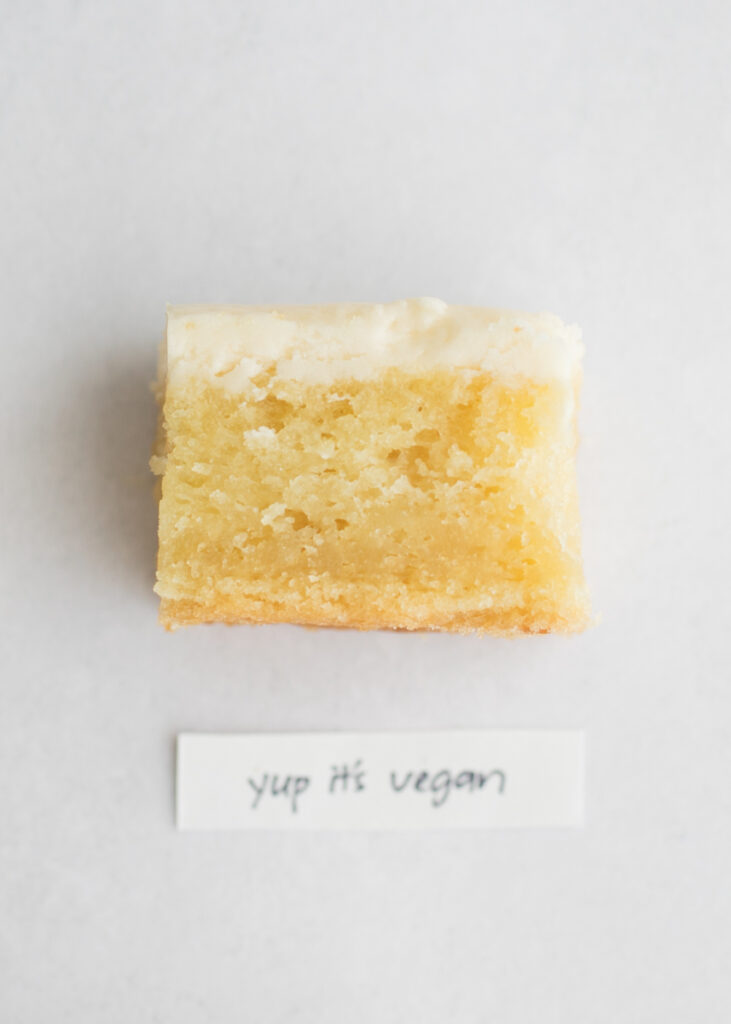
Yup It’s Vegan: a dense and almost crumbly cake with minimal vanilla flavor
Yup It’s Vegan was our only oil and shortening-based cake. Like other recipes using aquafaba, it just called for foaming the aquafaba (rather than whipping it to stiff peaks). Like Sugarologie, it uses a mix of vanilla and butter extracts, though it diverges by using cake flour and potato starch instead of all-purpose flour and chickpea flour. Note: this recipe suggests using a fork to mix the shortening into the dry ingredients (reverse creaming style!), but I just used my mixer.
The resulting texture was a very soft cake with an almost gummy-looking line at the bottom (which could have been baker’s error on my part, likely from over-creaming the batter). I was surprised by how much I enjoyed the combination of the fluffier cake on top and moist, dense bottom. Some other tasters also loved the moist and dense texture while others found it a little stodgy. To me, the cake barely had vanilla flavor, but the lightly salty vanilla frosting carried most of the flavor.
Despite my likely baker’s error, I suspect this cake might have some inherent structural issues. Just 24% cake flour to 33% milk was one of the highest liquid-to-flour ratios and using cake flour means even less structural stability than all-purpose flour. But it’s a recipe you might try if you love a moist, dense cake!
Taster comments:
- Phenomenal texture. Very moist. The flavor wasn’t doing it for me, and the frosting made zero impact. I just had the frosting and already can’t remember it.
- This might be an unpopular opinion but I love a good dense cake. This cake was nice and dense and a little wet, which might turn off some people but not me! The flavour was understated but still very classic vanilla.
- Cake feels a little denser but I really like how it tastes with the frosting. The frosting isn’t super sugary and they mesh very well. Actually tastes similar to a regular cake.
- This sample looks very dense and congealed but it’s softer than [Post Punk Kitchen] which I like. I will say that the taste of the cake itself tastes almost like straight cake batter–I’m not completely opposed, but it’s not the best. Overall, the flavor and consistency is very similar to a storebought vanilla cake.
- The frosting tastes like a grocery store jar of vanilla Betty Crocker frosting (good thing), but this cake was also a very dense and doughy texture that the frosting could not fix
- It’s sooo dense and a bit stodgy. I’m getting an aftertaste of an extract that isn’t very pleasant. Almost seems a smidge underbaked. Frosting is tasty and smooth
- Did not like the more chemical flavor in the cake, frosting a bit grainy, bottom was very close-textured, almost soggy.
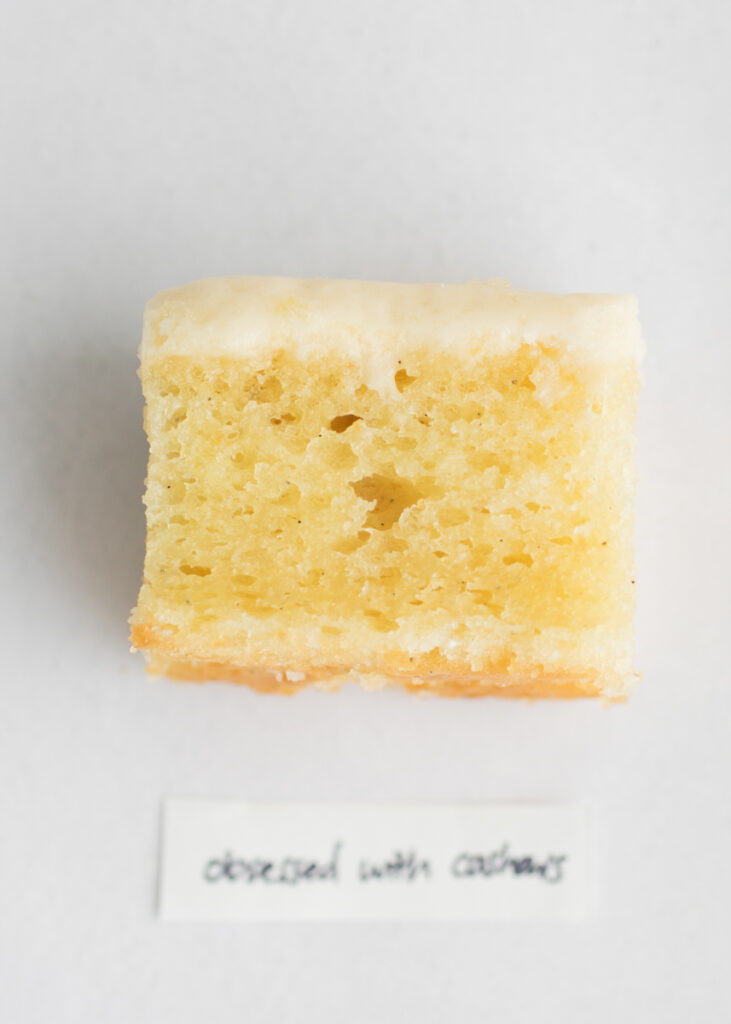
Obsessed with Cashews: a coarse-crumbed, sweet and faintly vanilla-scented cake
Obsessed with Cashews is another oil-based cake that uses cake flour, plant-based milk, plant-based yogurt and vinegar. I included this recipe as a foil to the more standard “wacky cake” formula, which generally uses oil, all-purpose flour, water and vinegar. To me, cakes with cake flour often outperform cakes using all-purpose flour, and I was curious to see if adding the vegan yogurt and milk would lead to a superior result!
Ultimately, I don’t think these changes led to a more desirable cake texture. This had a closer, moist yet not greasy crumb compared to Post Punk Kitchen. However, this was the second coarsest cake crumb overall, and it leaned drier/more pasty than I preferred. Despite using both vanilla extract and paste in this cake, the flavor was pretty mild. There were faint notes of vanilla, but mostly it simply tasted sweet. This cake felt overall largely unremarkable, but it is a very easy one to make using mostly pantry ingredients!
Taster comments:
- The cake was excellent, really nice and moist and spongy. The frosting was too sweet for my taste and overshadowed the flavour of the cake, which by itself was a lovely sort of nutty vanilla taste.
- Frosting is phenomenal, reminded me of canned frostings. Enjoyed the cake texture though the flavor was subtle.
- While the cake is denser, almost like a butter cake, it does have a distinct vanilla flavor missing from a lot of the other samples. The frosting is fantastic, with a thick whipped cream texture and just the right amount of sweetness.
- Frosting tastes buttery, nice fluffy texture. Very sweet. Cake is spongy to the fork with some chalkiness and a muffin-like crumb
- Super spongy, moist and almost pasty texture. Upon further inspection, spotting the flecks made it somehow feel classier than the initial hit of vanilla. Loved the icing, a thick but not too dense layer of total sugar sweetness.
- I’m thrown off because I can see the vanilla beans in the sponge, but it tastes oddly artificial to me, especially the frosting. Cake is a little too similar to a butter mochi texture and overall not my favorite
- Cake has similar texture to bread and not much flavor, frosting is too thick and sweet
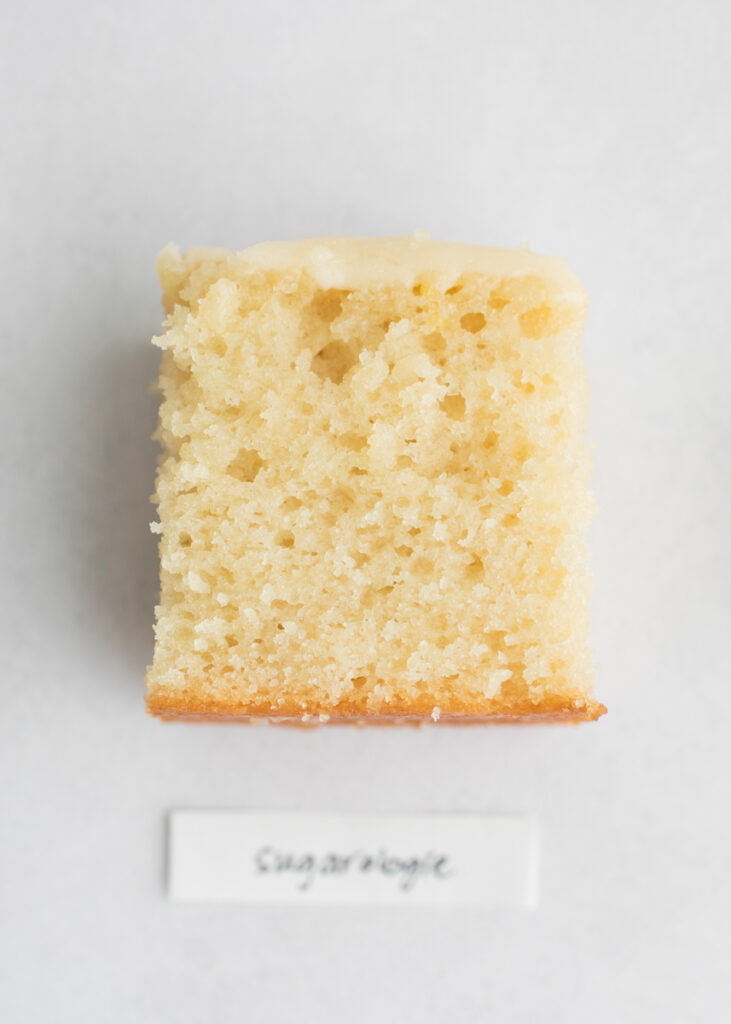
Sugarologie: almost cornbread-like in texture with a close, plush crumb and umami undertones
Sugarologie was the recipe I was most excited to test thanks to a few unusual techniques and ingredients. Technique-wise, it calls for first beating flour and water into a gluten paste to help build the gluten structure of the cake. Since we’re lacking protein from the eggs, Adriana suggests that gluten can provide the structural scaffolding instead.
This is an oil-based cake, but Adriana adds optional white miso paste to mimic the savory undertones you get from egg in conventional desserts. She also adds chickpea flour for structure and nuttiness along with butter and vanilla extract to get a vanilla-forward cake flavor. Butter and vanilla extracts also go into the frosting, which uses a sugar syrup (I used corn syrup) along with vegan butter and powdered sugar.
This had such an unusual cake texture–it almost feels like it has the thickness and density of a cakey cornbread but with a close, moist and plush crumb. There’s also a pleasant springiness that I’d like to credit to the initial gluten development. Perhaps it was my brand of miso or butter extract (McCormick), but the savory depth of flavor from the miso actually overpowered the vanilla flavor of the cake. Next time, I’d try this with half the amount of miso paste.
I also found the frosting a bit sweet and a little softer than I’d prefer (I prefer a classic buttercream, no corn syrup needed). Though a bit thicker and heavier than I prefer for a cake, I could see myself really enjoying this as a snacking cake or layered with a heavier buttercream.
Taster comments:
- Cake so moist!!!! Incredible!! Frosting had an interesting custardy texture but didn’t blow me away. Maybe slightly odd aftertaste from frosting?
- Very moist and well-balanced. Vanilla flavor is present but not overpowering. Not too buttery, which I liked. Clean and enjoyable, one of my favorites
- Really good height and crumb. The smoothest and tastiest frosting of the bunch. The flavour of the cake is good too (almost buttery) but with a slightly flour-y aftertaste. Overall really good.
- I like the texture of the cake though it does seem a bit grainy, almost like cornbread. The frosting is nice, almost like a cream cheese type of flavor. Slight aftertaste that I don’t love.
- The cake base tastes more glutinous-like than a regular cake (sticks together more in your mouth). There’s an oil aftertaste that I’m unsure about. Frosting by itself tastes good (kind of like buttercream which I love).
- The cake had a weirdly gummy texture. The frosting was okay, mostly tasted like butter flavoring (which I don’t mind but don’t love)
- The saltier butter (vegan substitute of it), was what threw the frosting off. It was too buttery and salty to give any flavors of vanilla. The cake wasn’t very bad in itself, the frosting just brought down the overall cake rating.
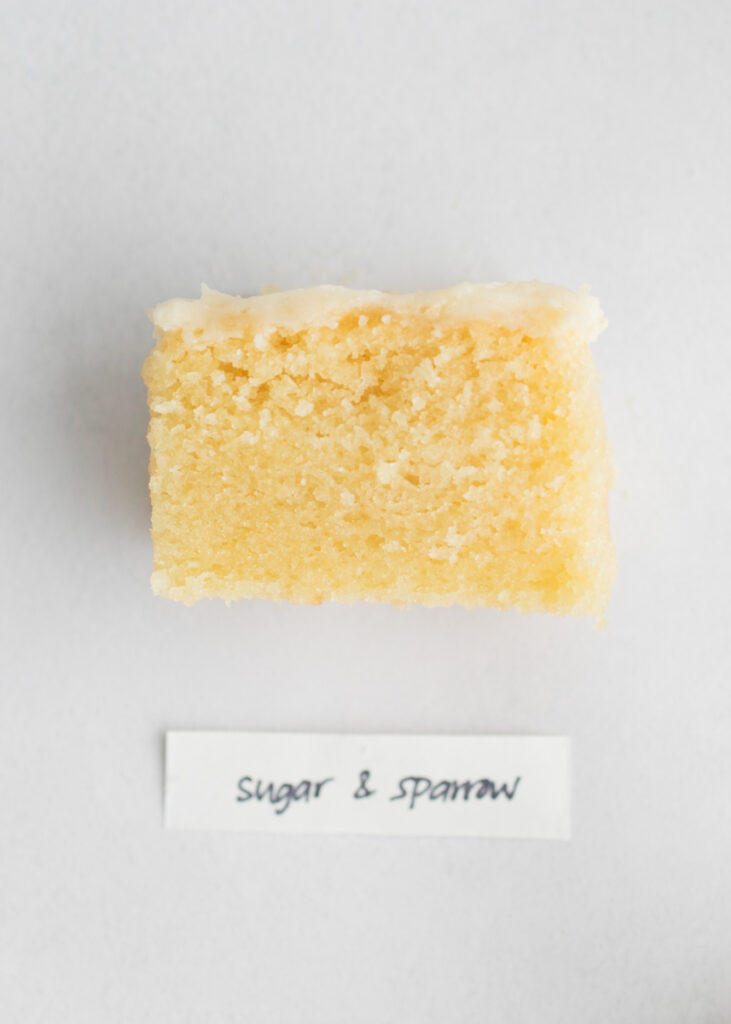
Sugar and Sparrow: a soft and bouncy close crumb that almost melts in your mouth
Sugar and Sparrow is an all-vegan butter cake that uses cake flour, soy milk and aquafaba. Similar to Nora Cooks, it uses the creaming method and just slightly foamed (but not whipped) aquafaba. Despite its similarity to Nora Cooks and overall straightforward nature, this recipe gave me some of the most trouble. It came out with a gummy bottom texture, so I baked it again–only to end up with the exact same texture.
If we focus on the top half of the cake, the cake has a soft yet bouncy, almost glutinous crumb that’s both tender yet crumbles on the tongue. The unusual texture led a few tasters to describe this as similar to a mochi cake. This was another cake that wasn’t super flavorful–there’s not a ton of vanilla flavor in the cake itself; you mostly get sweetness. For a cake that uses cake flour, this has a relatively close and sturdy crumb. This might be a good option if you want a delicate yet bouncy crumbed cake.
Taster comments:
- Delicious flavor, almost cereal-like with a roasty note. The frosting was so tasty and very light. I liked the cake to frosting ratio as well.
- I really like the cake on this sample. It’s a bit crispy and I was thrown off by it at first but I like the texture. I think the crust of the cake adds to the flavor. The cake is what I would describe as like very homemade (in a good way!), like something your grandmother would make with a recipe that has been handed down generations. I think the frosting is ok, not like crazy nice on its own but I think with the cake, it’s good.
- This cake tasted almost like a mochi cake, buttery and dense but with a more interesting texture than flavor. The frosting was very sweet, one-note but still pleasant to eat.
- Frosting is a little too sweet, and cake a little too moist. But the frosting and cake pair nicely together, better than tasting them separately.
- This one did not have any vanilla flavor coming through, the cake texture was sticky/dense and it had a floury after taste. The frosting felt very salty.
- Although I like the denseness and moistness of the cake, something about the flavour didn’t click for me. The frosting was a little less sweet than others, which I enjoyed!
- Wayyy too oily and dense (even for me, a lover of very moist cake)
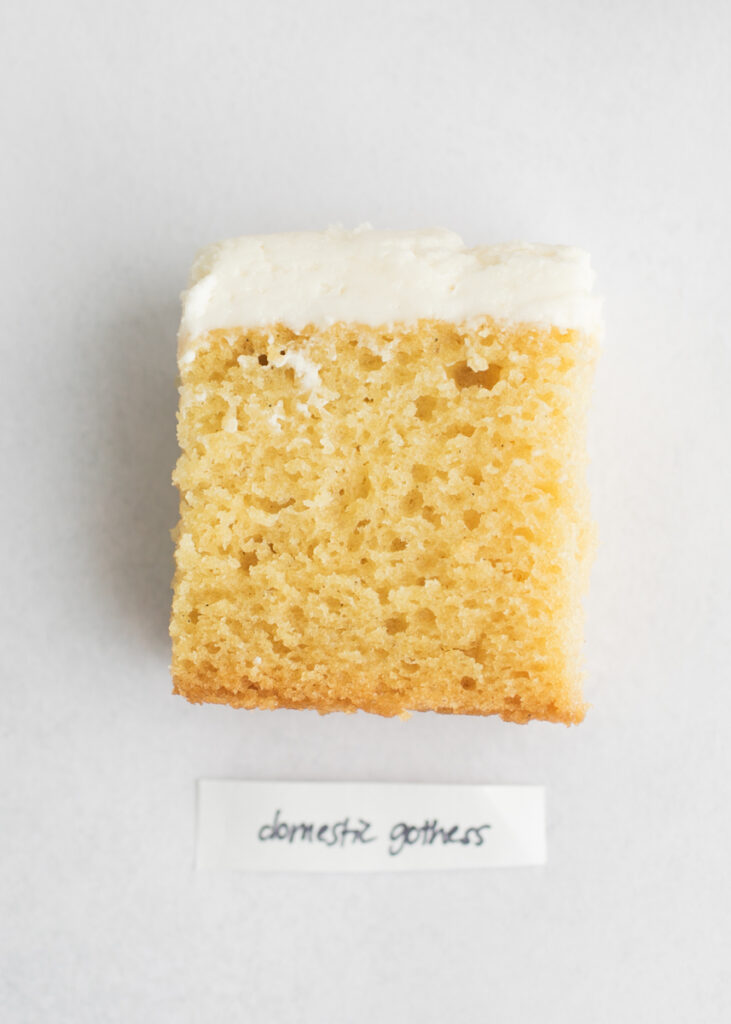
Domestic Gothess: a perfectly even, medium fine crumb with a great rise and spongy texture but slightly muted flavor
Domestic Gothess is one of two recipes that use all vegan butter as the fat source. Instead of using the creaming method, this simply calls for melting the butter into the wet ingredients and whisking the wet and dry ingredients together for a very straightforward cake. (Note: this recipe doesn’t call for salt but I took the liberty of adding 1/4 tsp salt. In my mind, this wouldn’t inherently change the recipe, but it’s a very minor tweak that would keep this cake on par with other recipes and prevent it from getting docked from a lack of seasoning/salt balance.)
This cake came out with a very nice, even, medium-open crumb with a tall rise that stood out among the cake recipes. The slightly spongy texture and open crumb almost leans more in the direction of a loaf cake vs. a delicate cake layer, but I liked that the structural integrity felt very solid! This cake was quite bland; I wished for a bit more sweetness and vanilla flavor in the cake, but I did love the vegan butter/shortening hybrid frosting, which was a sweet, bright white buttercream.
To me, this felt like a more nicely textured version of Post Punk Kitchen with a more even, close crumb. Both cakes have very similar ratios, but I think the vegan butter performs better in this simple type of cake. It’s a very pleasant cake texture (similar to Sugarologie but lighter, slightly less moist and bouncier) with a somewhat forgettable flavor.
Taster comments:
- This is the one. This one is so good on a whole bite. The frosting is definitely super sweet, which is *exactly* my thing and it has a very specific kind of frosting texture that I personally love — the slightest and most consistent of microcrystalline grain that’s subtle enough not to be annoying (i.e., gritty) but definitely present. While the cake’s flavor isn’t anything to write home about, the texture is moist and plush, and this was the tallest sample in the box, so I was pleased to find out it’s *also* airy. Just all-around totally my kind of cake. A little extra kick in flavor somewhere (oooh, orange blossom water?!) in some manner would probably make it perfect to me.
- The cake and frosting in this sample both taste great, but they are better apart than together. The frosting is almost toothsome, with a balanced sweetness. The cake is soft and vanilla-forward, with an even crumb, but with the frosting, you can barely taste its subtlety.
- The cake is amazing – very soft and fluffy and the flavour reminded me somewhat of the nuttiness of [Obsessed with Cashews]. The frosting on the other hand was too sweet for me and overshadowed the cake.
- Beautifully tall! The texture wasn’t particularly oily but I thought it had the flavor of the oil. Other flavors: green, chalky, Pillsbury vanilla, raw. Muffiny crumb that gives more of a snacking cake than a cake cake.
- The frosting was better than the cake because it had more of the vanilla flavor. The cake had a nice texture, but it tasted less like vanilla and a little like a cornbread.
- For me, the cake was dry and had a lingering aftertaste that I didn’t like, bordering on artificial sweetener. The frosting also tasted very sweet and artificial.
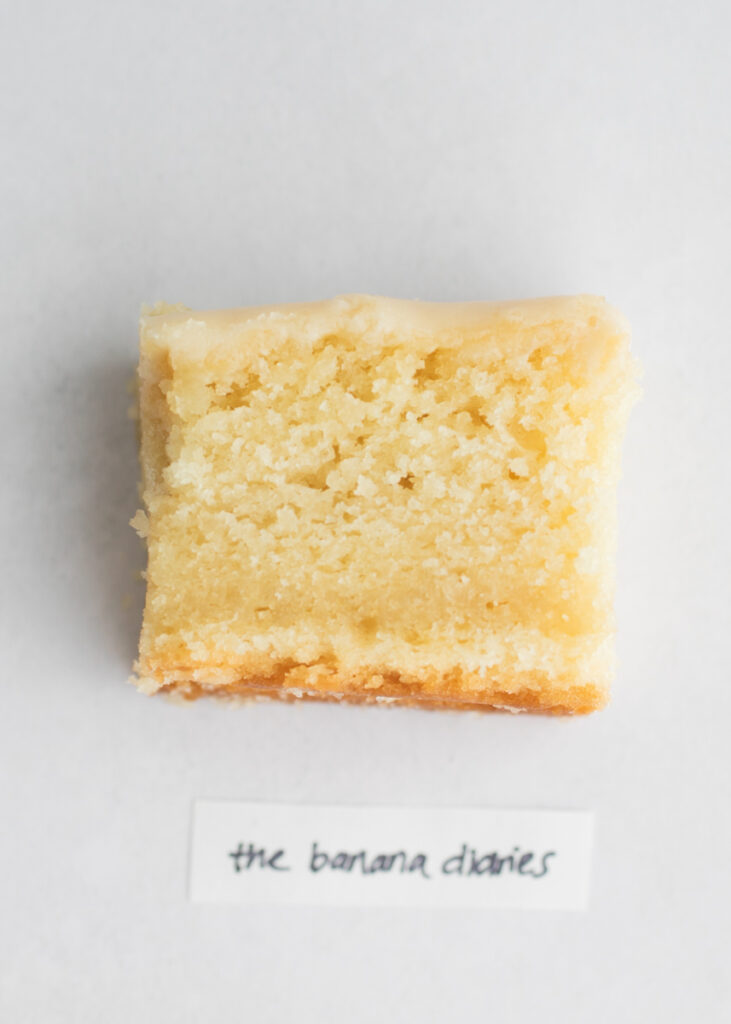
The Banana Diaries: a fall-apart tender texture with a strong vanilla flavor
This and the following two recipes have a few things in common: all use cake four and a mix of oil and vegan butter. The Banana Diaries uses the highest ratio of vegan butter with just 2 tbsp of oil (13% butter and 1% oil–see above recipe composition chart) along with vegan buttermilk and dairy-free yogurt.
Although you can see a slight gummy line on this cake (potentially due to overmixing on my part), tasters still loved this cake. From the photos, I expected this cake to have a thick and dense texture but it actually has a fine and delicate crumb that has a similarly crumbly fall-apart tender texture to Nora Cooks and Thank You Berry Much. As one taster noted, it somehow does strike a balance of almost having a doughy quality, yet also a delicate crumb??
On day one of tasting, I preferred Nora Cooks but upon the second day of tasting, this was actually my first place cake. Flavor-wise, this was my second favorite flavor with nice notes of vanilla and a fairly balanced sweetness. I would happily make this cake again.
Taster comments:
- I like the cake of this because it’s kind of in between being soft and sturdy. The cake is less moist than [Nora Cooks] but I genuinely think the overall combo of the cake with this frosting is very good. The frosting is thin so it’s not overbearing which I also like. It seems very homemade and I like the flavor of it a lot.
- Nice, well balanced frosting. Cake is solid, a little gummier than [Nora Cooks] but not nearly as gummy as [Sugarologie]. Good vanilla flavor. This is my fave so far.
- Something about the texture of this cake feels very much like a corncake. Like there’s a slight coarseness (not graininess) to the crumb that feels reminiscent of things that have cornmeal in them.
- Cake is a little too dense but doesn’t have an oil aftertaste. Kind of is borderline a loaf rather than a cake in my opinion.
- Both the cake and the frosting were pretty dense with an almost doughy quality to the cake. The frosting had a noticeable fake butter flavor
- Tasted the most vegan of them all to me – icing was thin, cake was dense and tasted breadier / healthier somehow? Maybe vaguely like cornbread
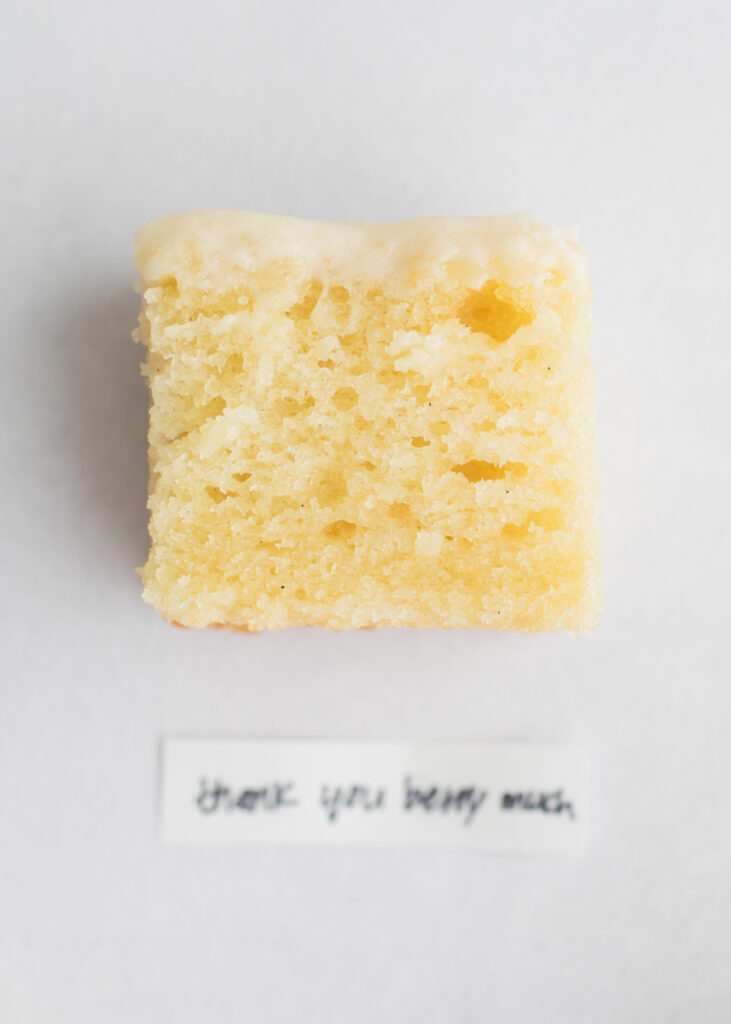
Thank You Berry Much: a soft and fine crumb that feels just like a conventional vanilla cake
Thank You Berry Much is our second cake using oil and vegan butter, but this recipe uses just a slightly higher ratio of butter to oil. Like The Banana Diaries, this also uses vegan yogurt and what shakes out to be vegan buttermilk (soy milk + vinegar). I included this recipe partially to test the different oil/butter proportions, but also because it uses my favorite cake technique–reverse creaming.
Surprisingly, I actually preferred the texture of the regular creamed cakes (Nora Cooks and The Banana Diaries) over this texture! To be clear, it’s still an excellent cake–the crumb is soft and fine and so delicate that it almost crumbles apart. No spring or bounce to the crumb here! I suspect the additional splash of vinegar helps give this cake a bit more lift than The Banana Diaries.
While you get a good vanilla flavor from the vanilla extract and paste, I slightly preferred the clearer vanilla flavor in Nora Cooks. If you’re trying to decide between this cake and the very similar The Banana Diaries recipe, I would choose this recipe if you like a little more of an airy crumb and The Banana Diaries if you prefer a more doughy quality to your cake crumb.
Taster comments:
- This is my favorite cake. There’s a really nice buttery undertone to the cake that’s balanced out by how fluffy and airy the texture is. The frosting is sort of the same as the other samples that I rated lower because it’s too sweet, but the cake itself is fantastic.
- The most like a regular (non-vegan) vanilla cake by far! Softest, cakiest and most distinct crumb with a pleasant frosting. Would definitely be my pick to make for a group of people where both vegans and non-vegans can be happy
- This is the closest to a non-vegan taste out of the batch. So delicious and fluffy, and the frosting had incredible flavor. It was very light, and didn’t feel too rich or sweet.
- Cake has a perfect rise and texture in my opinion. I also love the flavor of the frosting, but it left a sort of film in my mouth
- Middle of the bunch for me. Overall flavor of both cake and frosting is good, but cake alone has that weird aftertaste again. Has a light, airy texture that is nice.
- Chewy, vanilla-y, not too sweet cake with generic storebought tasting frosting. Pleasant, but not a go-to.
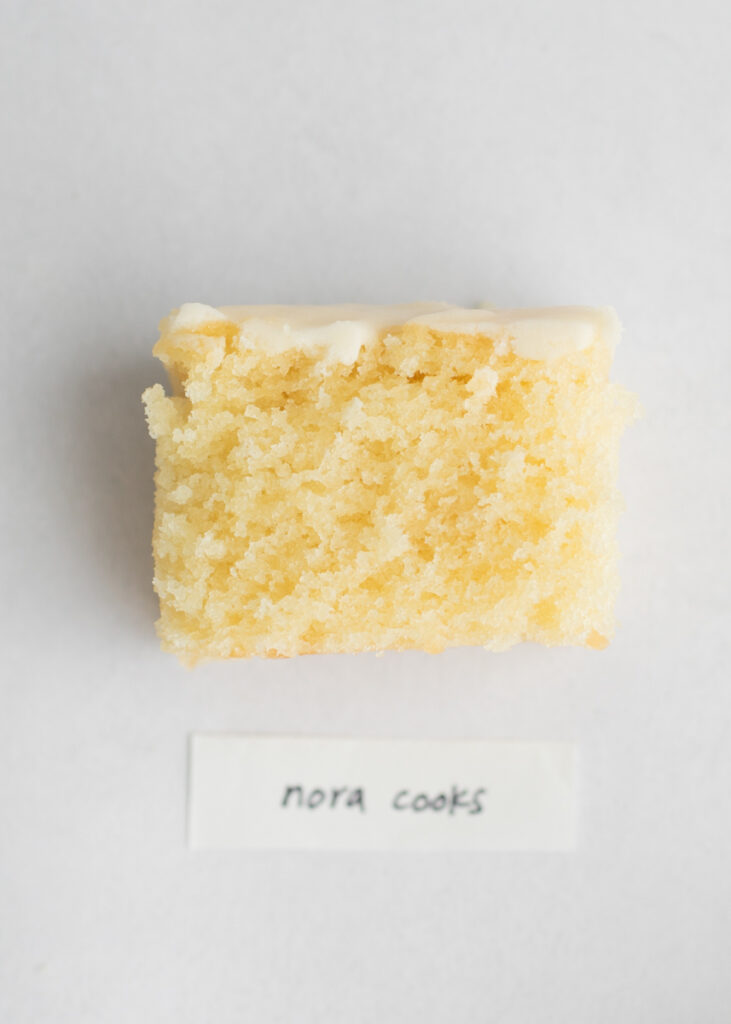
Nora Cooks: a loose, delicately-crumbed cake that just melts in your mouth with a strong vanilla flavor
Nora’s recipe is our last oil and vegan butter-based recipe, using a 1:1 ratio of oil to butter. It differs from The Banana Diaries and Thank You Berry Much in that it uses aquafaba instead of vegan yogurt. Interestingly, this recipe is very similar to Sugar and Sparrow (S&S uses all oil and no cream of tartar) but they turned out quite differently. Unlike Thank You Berry Much, this recipe calls for the regular creaming method in the cake. (Note: if you don’t have aquafaba on hand, Nora suggests a vegan yogurt substitute.)
And this cake blew me away during the tasting! My preference is always for a cake that has a finer, more delicate crumb–I don’t mind if it crumbles as long as it melts in your mouth, and that’s exactly what this cake did. On day one, it was so light and airy and cakey, though it settled into a cake that was a bit more moist and squishy by the second day. Some people might prefer the slightly denser cake texture, but I preferred the texture on the first day.
This almost had a similar crumb to Sugarologie but lighter and airier with a stronger vanilla flavor. Flavor-wise, this was my favorite and is a cake I’ll happily make again and again!
Taster comments:
- This was so tasty! I couldn’t even tell it was vegan. Both cake and frosting complement each other well
- Absolutely delicious. The cake was slightly denser than ideal, but it had a light, appealing flavor, and the frosting tasted like the best version of childhood canned frosting. This is what a birthday cake should taste like.
- Cake tastes like a standard light cake (kind of like box mix but not in a bad way!), tastes the most normal. Frosting tastes like frosted sugar cookies from the store–a little sweeter than my liking.
- This is I think the most well rounded good cake + frosting combo. I would reach for this combo over others. Frosting texture not as good as [Obsessed with Cashews] but close. This cake had the best flavor, tasted golden and made me think of a Twinkie.
- This one is the one that feels most like it has dairy butter notes to the cake’s flavor despite the lack of it. That sort of lactic creaminess except with none of the *actual* creaminess in texture (heavy, oily, etc.).
- This one had the most vanilla flavor coming through. There was also a butterscotch flavor coming through that was a nice addition. The frosting was sweet, but complemented the cake well.
- Cake is a little less sweet and less vanilla-y than I would like, frosting is a little sweeter than I would like. They work better together than apart. The cake has a nice, fluffy texture.
Recommendations
Erika’s picks: Nora Cooks, The Banana Diaries
Crowd favorite (and best vanilla flavor): Nora Cooks
Best for a light and airy cake: Nora Cooks, Thank You Berry Much
Best for a deliciously dense texture: The Banana Diaries
Best rise and structure: Domestic Gothess
Best complex flavor: Sugarologie
Best fast and easy snacking-style cake: Post Punk Kitchen

Susie
This is literally so helpful thank you so much! I’m not vegan but my mom is and whenever I bake for her I’m always stuck comparing multiple recipes for hours so thank you so much for the analysis!! Also I’m curious if there is a chance of a souffle bake offs possibly happening in the future? Thank you!
erika
Oooo souffles would be tough but a fun challenge–maybe!
Akhila
omg this is so helpful! your vegan bake offs are so useful to me!
erika
So happy to hear!!